Résultat de la recherche : 'store'
|escaper|escapen|escapetAfrican Art on the Internet |escaper|escapen |escaper|escapen|escapet |escaper|escapen |escaper|escapen|escapet |escaper|escapen |escaper|escapen|escapet |escaper|escapen |escaper|escapen|escapet15th Triennial Symposium on African Art, Arts Council of the African Studies Association, 2011, Wednesday, March 23 - Saturday, March 26, 2011, UCLA, Los Angeles, California |escaper|escapen |escaper|escapen|escapethttps://www.acasaonline.org/conf_next.htm |escaper|escapen |escaper|escapen|escapetAddis Art - Ethiopian Art and Artists Page |escaper|escapen |escaper|escapen|escapetContemporary Ethiopian art and artists - paintings, sculptures and digital art work by students and professionals from Addis Ababa, Ethiopia. University instructor, Getahun Assefa's paintings, drawings, sculpture, digital art. Also work by his brother, Tesfaye Assefa. Based in Addis Ababa, Ethiopia. [KF] https://www.addisart.com/ |escaper|escapen |escaper|escapen|escapetAddis Art - Nouveau Art from Ethiopia |escaper|escapen |escaper|escapen|escapetArtists include Shiferaw Girma and Lulseged Retta. Photographs of each artist's work, a biography, and video. Founded by Mesai Haileleul. [KF] https://www.addis-art.com/ |escaper|escapen |escaper|escapen|escapetAdire African Textiles - Duncan Clarke |escaper|escapen |escaper|escapen|escapetHistory, background, and photographs of adire, adinkra, kente, bogolan, Yoruba aso-oke, akwete, ewe, kuba, and nupe textiles. The symbolism of images is often provided. One can purchase textiles as well. Clarke's Ph.D. dissertation (School of Oriental and African Studies) is on Yoruba men's weaving. See also the Adire African Textiles blog. Based in London. https://www.adireafricantextiles.com/ |escaper|escapen |escaper|escapen|escapetAfewerk
[ Lire la suite... ]
|
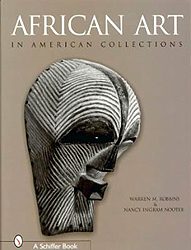
ROBBINS M. Warren & NOOTER Nancy Ingram
African Art in American Collections (ISBN-10: 076432005X - ISBN-13: 978-0764320057)
Descrizione libro: Relié: 616 pages - Editeur: Schiffer Publishing Ltd; Édition: 2 (1 janvier 2004) Langue: Anglais. Hard Cover with dust jacket. 9x12 in. Collector Bookstore is a retailer of new books located in Leavenworth, Kansas. We specialize in price guides and reference books for the antiques and collectibles industry. African art -- with its powerful forms, complex symbolism, and formal inventiveness -- has only recently come to be recognized as one of the great artistic traditions of mankind. This rich tradition is showcased here in a remarkable selection of outstanding works. Nearly 1,600 objects are illustrated, each accompanied by scholarly information on style, usage, meaning, and cultural origin. Featured individually by section are the styles of Western Sudan, the West African Coastal Region, West Central Africa, Central Africa, and Eastern and Southern Africa. A thought-provoking introduction helps readers understand the significance of African art as a form of human creative expression, its relationships to contemporary Western art, and the controversies surrounding it in the world's museums. Newcomers to the field as well as professionals will find many questions answered in the text and captions. FThis comprehensive survey of some 230 styles of African art is an essential reference for scholars, teachers, students, curators, collectors, and
[ Lire la suite... ]
|
Full text, digitalised by Lies Strijker and presented by the .Centre Aequatoria
Notes on the digitalisation and presentation
[Cover]
[1: empty]
[2]
IMPRIMI POTEST
Kanzenze, 12-2-1952
P. Simeon, o.m.f.
Sup. Reg.
IMPRIMATUR
Luabo-Kamina, 30-5-1952
+VICTOR PETRUS KEUPPENS
Vic. Ap. de Lulua
[3]
BANTU PHILOSOPHY
by
The Revd. Father PLACIDE TEMPELS
(Translated into English from "La Philosophie Bantoue" the French Version by Dr. A. Rubbens of Fr. Tempels' original work. The Revd. Colin King, M.A. Translator.)
With a Foreword to the English Edition by Dr Margaret Read, C.B.E.Ph. D.,M.A., formerly Professor of Education and Head of the Department Of Education in Tropical Areas, The
[ Lire la suite... ]
|
Walker Evans
Walker Evans
Il est né le 3 novembre 1903, à Saint-Louis, Missouri. Il étudie au Williams College en 1922-1923 et à la Sorbonne en 1926. Evans débute la photographie en 1930. Il obtient une bourse de la Fondation John-Simon-Guggenheim en 1940, 1941 et 1959. Il entre au magazine Time en 1945 et à Fortune en 1965. Cette même année, il devient professeur de photographie à l'école d'art de l'Université Yale. Il est mort le 10 avril 1975, à New Haven, Connecticut.
On connaît notamment son travail sur la Grande dépression, participant au programme de la Farm Security Administration. Les images de métayers dans l'Alabama, au même titre que celles de Dorothea Lange, comptent parmi les icônes du monde moderne.
On remarque dans son travail les regards des sujets fixant l'objectif de Walker Evans : ici pas de doute le sujet se sait photographié, pour autant il ne se compose pas un visage de circonstance orné d'un sourire obligatoire. Ici la photographie ne se contente pas de montrer, elle interroge le spectateur, l'américain des années 1930 : si le sujet se laisse photographier dans cette posture, c'est que son regard a quelque chose à nous dire. Ce n'est peut-être plus nous qui le regardons mais lui qui nous accuse.
Cette franchise du photographe préserve une dignité humaine mise à mal par la misère qui se laisse voir dans les vêtements en loques.
Cet aspect de ses photos est
[ Lire la suite... ]
|
galeries art africain,gallerie art africain, galerie art africain, galerie d art africain, art,sculptures, art sculpture, galerie d art,galerie art en ligne, galerie art contemporain, expo art africain, galerie, exposition art africain, achat art contemporain, exposition, expositions, art africain, art premier, art primitif, arts premiers, arts primitifs, art, arts, primitif, primitifs, primitive, premier, premiers, tribal, tribals, african, africain, oeuvre, oeuvres, musée, museum, antiquités, antiquaire,antiques, Paris, Orsay, Verneuil, Mona Lisa, Louvre, galerie, gallery, Africa, Afrika,Afrique,histoire, history, art objects, objects, mask, masks, masque, masques, statues,statue, fétiches, fétiche, carving, siège, seat, appuie-nuque, artiste, artistique, achat,vente, expertise, Picasso, André, Breton, Jacques, Kerchache, Vlaminck, Quai Branly, Marcel,Griaule, Jean, Rouch, Cameroun, Bamiléké, Bamoun, Dogon, Bandiagara, Nigeria, Côte d'Ivoire,Ivory Coast, Liberia, Yoruba, Baoulé, Sénoufo, Kota, Bambara, Ashanti, Ghana, Bangwa, Cokwe,Tchokwe, Kifwebe, Burkina Faso, Gabon, Fang, Punu, Ethiopie, Ethiopia, Benin,art art africain primitif art primitives art mask yoruba african arts primitifs art arts premiers art africain expert gallery african galerie d'art africain masque statue art d'afrique noire exposition primitive tribal africa afrika, premier, premiers, art premier, arts premier, art premiers, arts premiers, musee art premier, musee arts premier, musee arts premiers, les arts premiers, les arts premier, les art premier, galerie art premier,galerie arts premier, galerie arts premiers, exposition art premier, exposition art premiers,exposition arts premiers, primitif, primitifs, art primitif, arts primitif, art primitifs,arts primitifs, musee art primitif, museearts primitif, musee arts primitifs, les arts primitifs, les arts, primitif,
[ Lire la suite... ]
|
|
Masks
The viewing of masks is often restricted to certain peoples or places,
even when used in performance, or masquerade. African masks manifest
spirits of ancestors or nature as well as characters that are spiritual
and social forces. During a masquerade, which is performed during
ceremonial occasions such as agricultural, initiation, leadership and
funerary rites, the mask becomes the otherworld being. When collected
by Western cultures, masks are often displayed without their costume
ensemble and lack the words, music and movement, or dance, that are
integral to the context of African masquerades.
Visually, masks are often a combination of human and animal traits.
They can be made of wood, natural or man-made fibers, cloth and animal
skin. Masks are usually worn with costumes and can, to some extent, be
categorized by form, which includes face masks, crest masks, cap masks,
helmet masks, shoulder masks, and fiber and body masks. Maskettes,
which are shaped like masks, are smaller and are not worn on or over
the face. They may be worn on an individual’s arm or hip or hung on a
fence or other structure near the performance area.
Sculpture
The cultures of Africa have created a world-renowned tradition of
three-dimensional and relief sculpture. Everyday and ceremonial works
of great delicacy and surface detail are fashioned by artists using
carving, modeling, smithing and casting techniques. Masks, figures,
musical instruments, containers, furniture, tools and equipment are all
part of the sculptor’s repertoire.
The human figure is perhaps the most prominent sculptural form in
Africa, as it has been for millennia. Male and female images in wood,
ivory, bone, stone, earth, fired clay, iron and copper alloy embody
cultural values, depict the ideal and represent spirits, ancestors and
deities. Used in a broad range of contexts--initiation, healing,
divination,
[ Lire la suite... ]
|
|
|